
Analyzing Formula 1 data
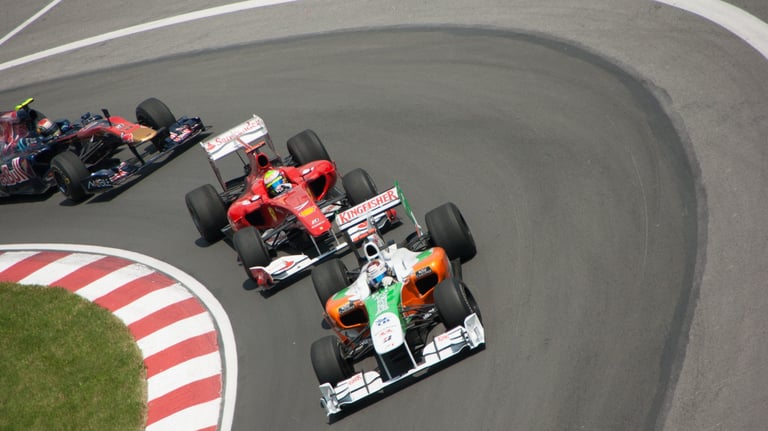
The first of what I hope will be a series of articles published on Medium.com and videos about Formula 1, telemetry data, and the analytics that can provide deeper insights into the sport, the tracks, the cars, and the strategies involved.
Part 1 - How do I get some data, anyway?
Join me as I delve into the fascinating world of Formula 1, exploring the sport's growing popularity and the intricate details of its diverse tracks. I aim to provide insights into how teams can optimize their performance.
Part 1 - How do I get some data, anyway?
Discover the data that is publicly available and how to retrieve it for deeper analysis of the nuances of track characteristics, driver styles, and the evolving nature of Formula 1 racing.



How to build a customer churn prediction model
A series of three articles published on Medium.com exploring how to build a customer churn prediction model.
These are focused on how the business requirements and planned use will impact the approach to the model development and the choices made in the process, rather than the technical details of the algorithms or the code.
Part 1 - What is churn, anyway?

Addresses how different stakeholders might think of churn in different ways and how to identify these.

Part 2 - Which is the right algorithm, anyway?
Focuses on how to select the right algorithm based on the definition of churn and how it is measured.
Discusses how to make the results of the churn prediction model actionable.
Part 3 - How do I choose the right action, anyway?
I was featured in one of a series of commercial spots used for a global online campaign in 2015 to promote the use of predictive analytics and data science.
I worked closely with the agency to provide input for the script and ensured that the language was my own and reflected my experiences.
Achieving business transformation with predictive analytics
IBM Corp.
August 2015


Wimbledon 2012:
A look at how the IBM SlamTracker works
Live@Wimbledon
July 2012
Interview by presenter Rob Walker during The Championships (better known as Wimbledon) in 2012.
Recorded while I was onsite at the All England Lawn Tennis and Croquet Club (AELTC) to support both the IBM online presence and the ESPN broadcasting team, I explain the fundamentals of the data-based Keys to the Match.

Keys to the Match:
Big data and analytics powering predictions
Talking Big Data at IBM
June 2013
Discussion between myself and David Pitman from IBM Big Data recorded prior to the Roland Garros tennis tournament (also known as the French Open) in 2013.
We discuss how the Keys to the Match was developed, how ESPN is using the results in their live broadcasts from the tournaments as the IBM Insights, and how the same techniques and algorithms are applied to business problems.
Tennis analytics
The most visible project I worked on during my time at IBM was for the four major tennis tournament - the Grand Slam Tournaments - for which IBM at the time was the primary technology partner.
IBM later entered into an agreement with ESPN, who had the broadcasting rights in the United States, that allowed ESPN to reference the analytics that I was doing on-air. This gave me the chance to work directly with the ESPN production team and commentators during the tournaments to ensure that the results were treated correctly on-air and that the graphics explaining the underlying work were accurate.


How unlikely was Wawrinka's Australian Open victory
The article examines the prior probabilities that Stanislas Wawrinka, who was seeded 8th in the tournament, would go on the win the 2014 Australian Open and puts his achievement into perspective.


In tennis, is it an advantage to serve first?
It is believed by many that there is an advantage to be serving in the first game of a set and, in particular, in the deciding set of a match. It supposedly gives the player a chance to easily get ahead and puts the pressure on the opponent, who is left to play catch-up throughout the set. It sounds compelling, but can it be supported by the rich data that is now available from the professional tennis tournaments?
The data story behind the "Keys to the Match"
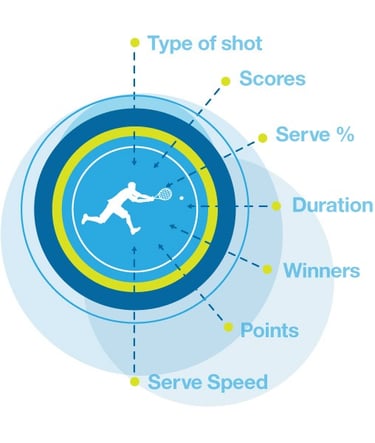
The article explores how the different playing surfaces between Wimbledon - which is played on grass - and the US Open - which is played on hard court - changes the way the game is played and how this is reflected in the statistics gathered by IBM. It is described how the differences between the two tournaments influence the "Keys to the Match" and the style of the individual players.
The Masters Golf Tournament and Tom Watson
Following on the success of the analytics and the Keys to the Match developed for the tennis tournaments, we started working with the data from the Masters golf tournament that IBM was also the technology partner for.
Tom Watson was scheduled to play his last Masters tournament in 2016 after having won the tournament twice and IBM wanted to celebrate his career and achievements at the Masters.
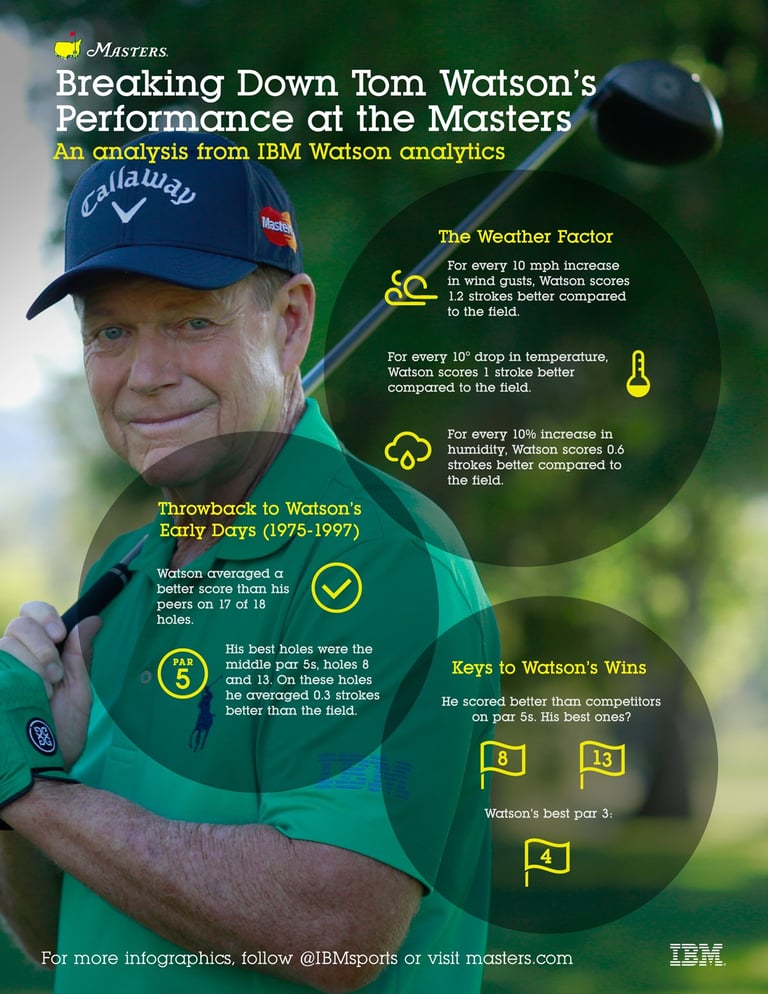
Breaking down Tom Watson's performance at the Masters
During the analysis of the Masters data, I found a large number of interesting facts about how Tom Watson played compared to his peers and what made him so successful at the Masters.
Since we could not fit all of the details into the brief TV spots that featured Tom Watson in conversation with IBM Watson, we created an infographic that was able to address a few more of the remarkable statistics that were uncovered and included additional details.
Kenneth A Jensen
A data science practitioner who will deliver results at every stage of the analytics lifecycle